A guide to buying a machine for welding plastics
A manufacturer of one technology will always confirm that their machine will weld your part, because they have nothing else to offer. We represent several European manufacturers, so we can afford to say when a technology does not suit your part. You find out straight away, not at the sampling stage with the tool finished and a deadline behind you.
Stand-alone machines start at EUR 40,000. If you need to weld plastics in smaller volumes, a separate page points you where to look.
What is on this page
Ten minutes of reading. Whoever you end up choosing, you will know what to ask.
Not with the technology and not with the price. Most bad purchases start by picking a machine first and only then finding out whether it suits the part. Find your case in the left column and you have the first answer.
| What you need | What is worth considering | What to avoid, and why |
|---|---|---|
| The joint has to stay tight under pressure reservoirs, filters, fuel parts | Vibration welding, hot plate, or spin welding on circular parts. | Ultrasonics on a large perimeter. The power thins out and the weld is only tight in places. |
| The weld must not be visible optics, visible surfaces | Laser. The weld sits inside the joint and the surface stays untouched. | Ultrasonics leaves a milky mark on clear parts, and a hot plate squeezes out flash. |
| There is electronics inside control units, sensors, boards | Heat staking, or laser on sensitive assemblies. | Ultrasonics wherever vibration could damage components or contacts. |
| You are joining plastic to metal or to a board | Heat staking. The stud goes through the hole and is formed into a head. | Welding as such. It will not join materials that do not melt into each other. |
| The material is plasticised PVC or coated textile | High frequency welding. The heat is generated inside the material. | Ultrasonics, the material absorbs the energy. On PP and PE high frequency welding does not work either. |
| The part is circular and made of two halves | Spin welding. The cheapest route to a perimeter weld. | Anything more complicated. You pay for it and the result is the same. |
| Every weld needs documented parameters safety parts, medical | Ultrasonic or laser welding with weld monitoring. The machine records how each weld went and rejects a bad part by itself. | A machine that records nothing. If a claim comes in, you have no way of showing the weld was right. |
| The weld has to take a fraction of a second small parts in large series | Ultrasonics. The weld itself takes tenths of a second. | A hot plate. Heating and cooling take seconds and cannot be left out of the cycle. |
| The joint area is large ducting, large assemblies | Vibration welding or a hot plate. | Ultrasonics. It does not have the power for a large area. |
If the table leaves you unsure, send us a photo of the part. Within 48 hours you have an answer, free of charge.
Do you make one-offs or small batches? Then the table above has probably pointed you at a machine that will not pay for itself. Stand-alone machines start at EUR 40,000 and only make sense from series production upwards.
So we wrote down where to look for equipment for smaller volumes and what to ask about it. Welding plastics in small volumes
Every supplier will tell you what their technology can do. The useful half is the second one, so it is written here as well.
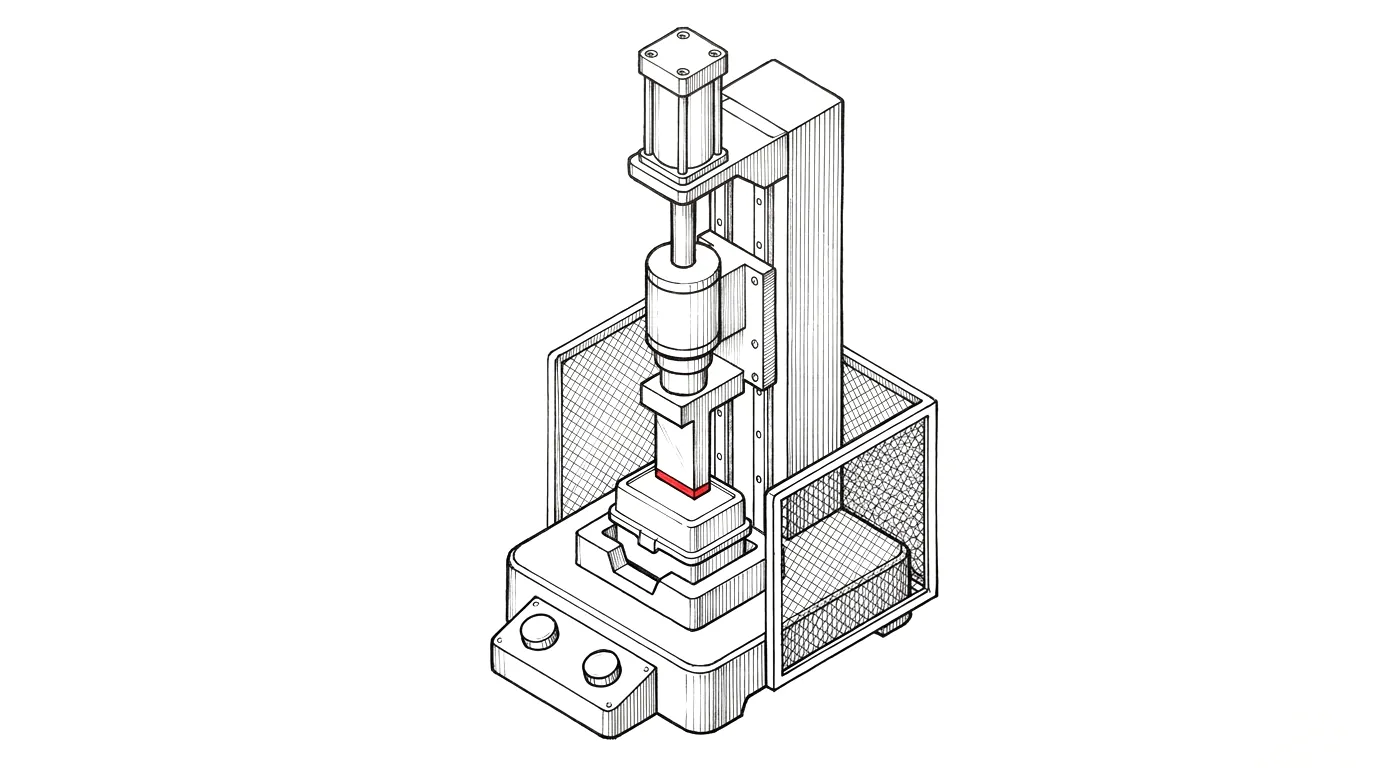
Small and medium parts, a perimeter weld up to roughly the size of your palm. The weld itself takes less than a second.
Limitations: Not enough power for large perimeters, and plasticised PVC will not carry ultrasound at all.
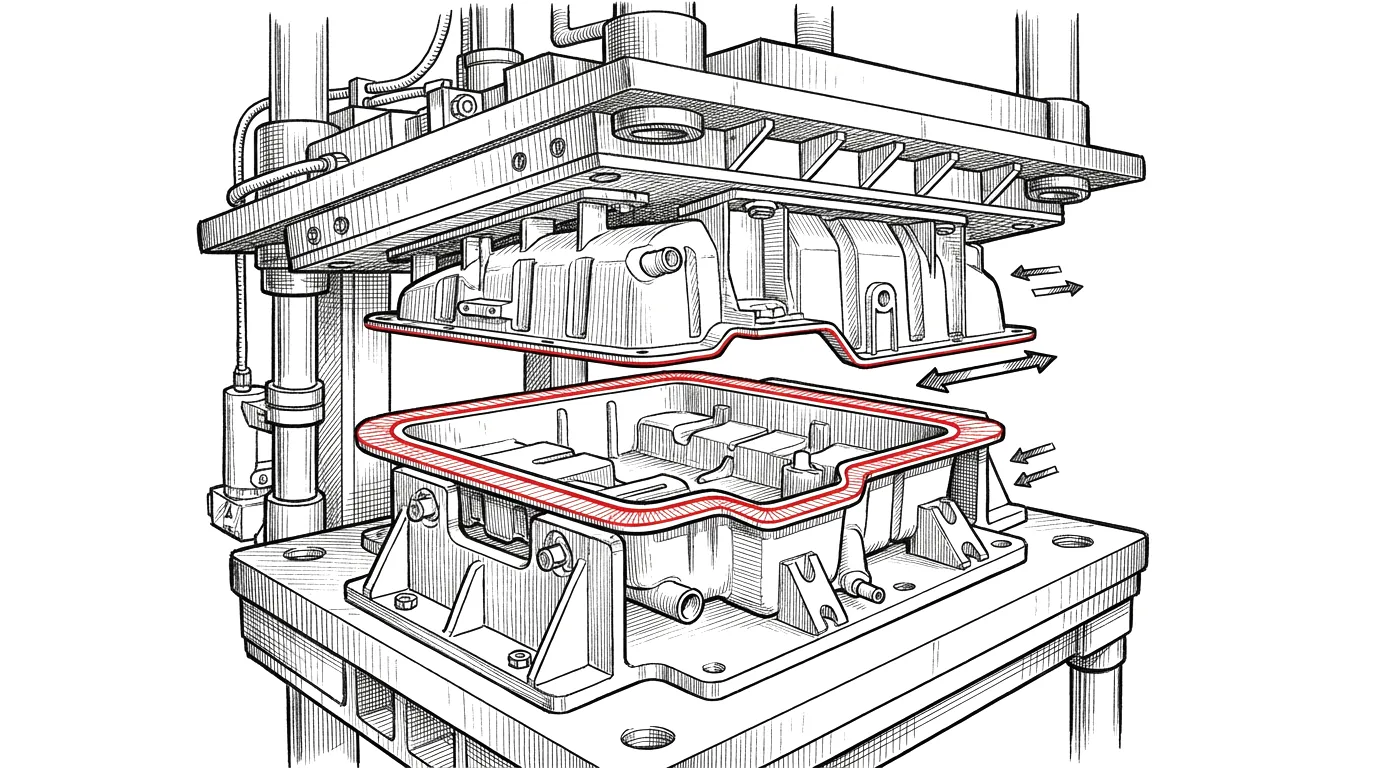
Large joint areas in one go. Reservoirs, ducting and assemblies that have to stay tight under pressure.
Limitations: The part has to take the movement. Not for thin-walled or shape-sensitive mouldings.
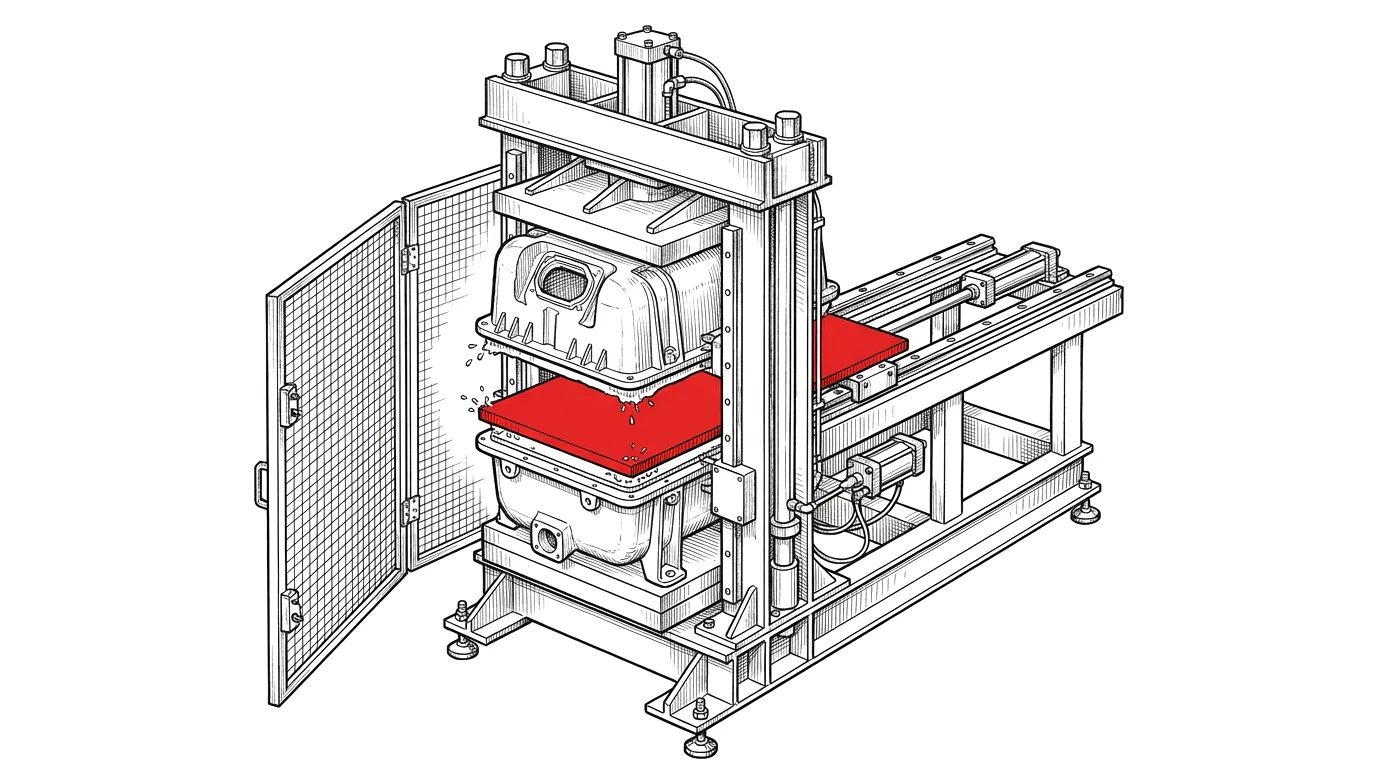
Large sections and long perimeter welds that ultrasonic power cannot reach.
Limitations: Longer cycle, and on thin walls the heat can distort the shape.
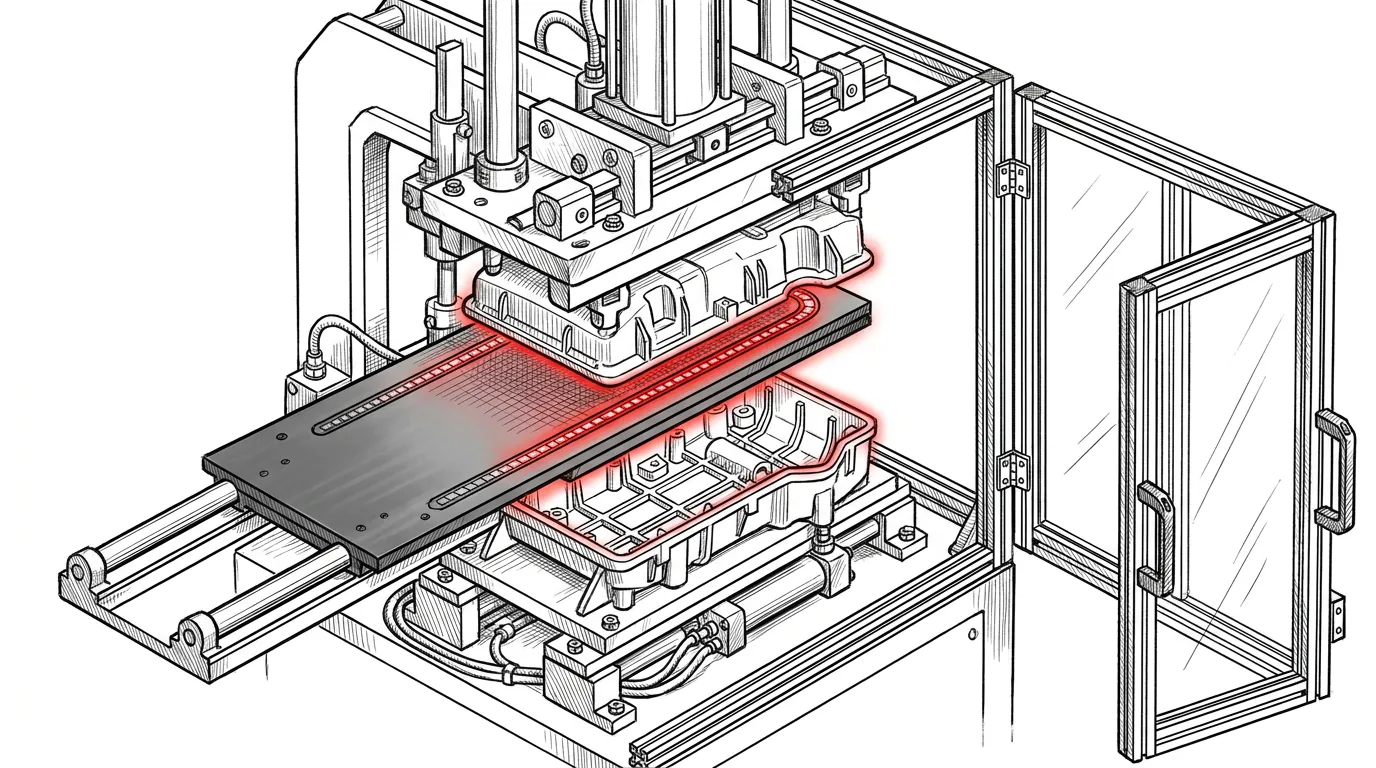
The same job as a hot plate, but without contact. Emitters heat the face from a distance, so nothing sticks to the tool and the cell stays clean.
Limitations: An emitter only heats what it can see. Shaded spots in a complex shape stay cold.
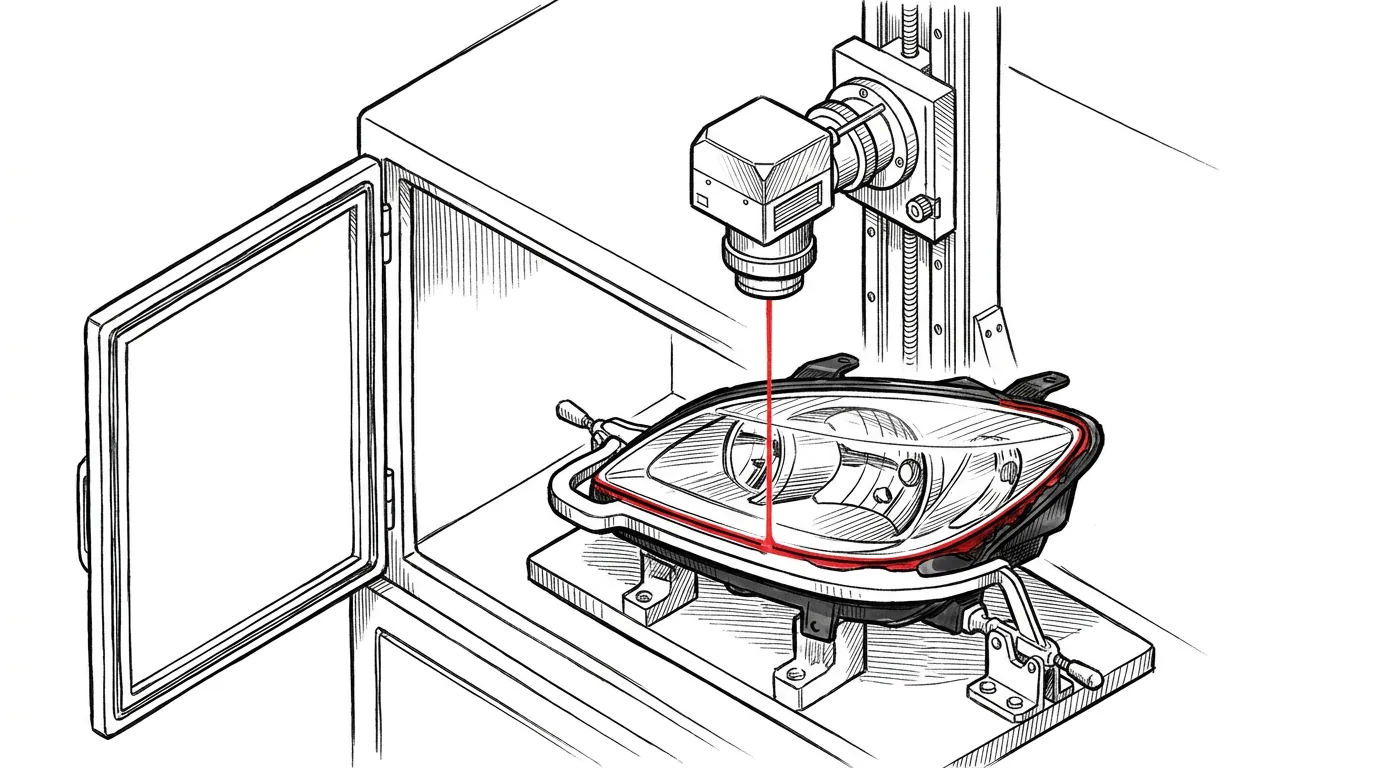
Where the weld must not be visible and must produce no debris or dust. Headlamps, optics, clean rooms.
Limitations: The upper part has to transmit the laser and the lower one has to absorb it.
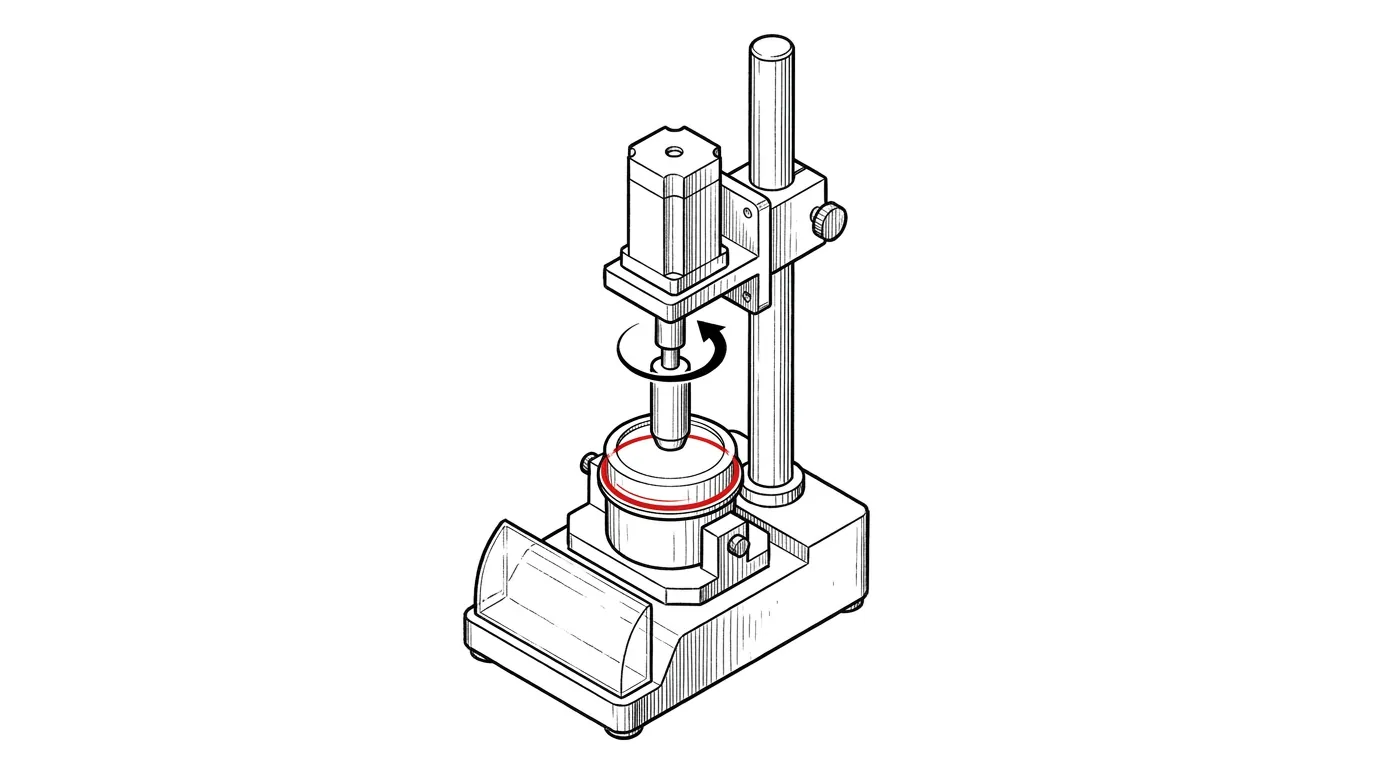
Circular parts made of two halves. Friction heats the material and joins it around the whole perimeter.
Limitations: Only works on a circular joint. If the parts have to end up in an exact position, the machine has to be able to stop at a set angle.
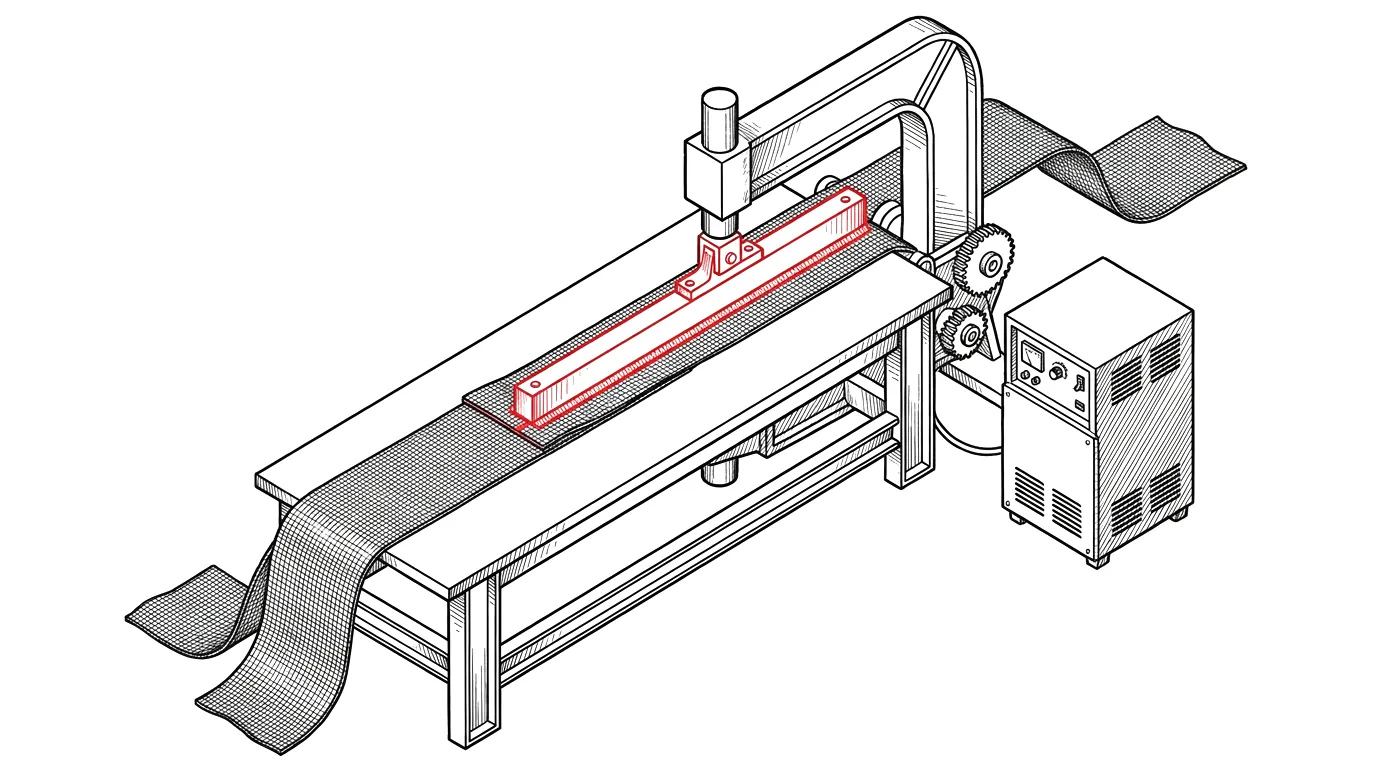
Films and coated textiles made of plasticised PVC. The heat is generated inside the material, not from outside.
Limitations: Only works with materials that have the right electrical properties. No use on PP and PE.
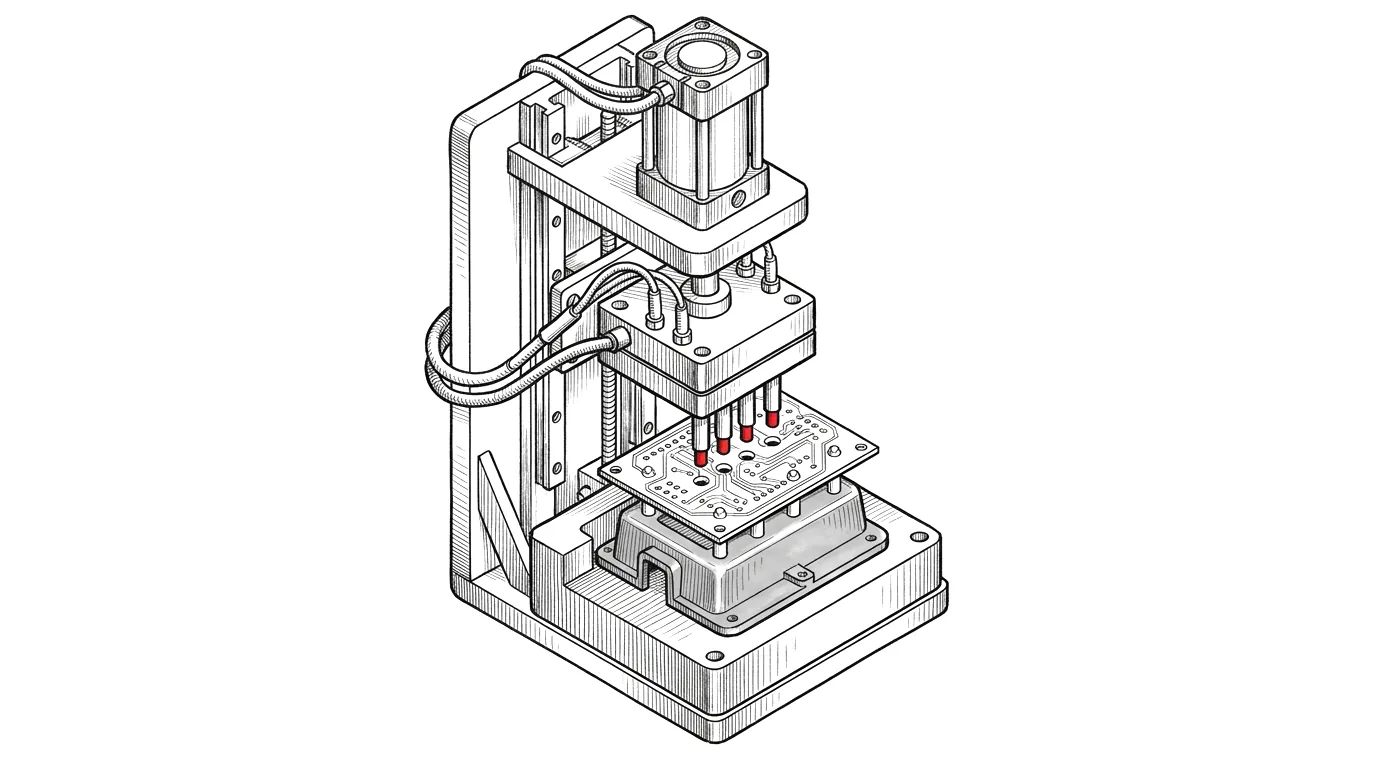
Joining plastic to metal, to a circuit board or several mouldings together. Without a screw and without adhesive.
Limitations: The studs have to be on the part straight out of the mould. They cannot be added later.
Two plastics only weld to each other when they melt into one another. That is why the first question is never how the part looks, but what it is made of. Different families of plastic will not join no matter what machine you buy.
Filler changes the answer as well. Glass fibre above roughly thirty percent makes welding harder for any technology, because there is less and less plastic in the joint to melt. Recycled content behaves the same way and, worse, it varies from batch to batch.
A joint that has to hold both plastic and metal is not a welded joint at all. There the answer is heat staking, where a plastic stud is formed over the other part.
What we need to know about the material:
If you do not know, send the part number and we will find out from the data sheet.
The most expensive mistake in the whole project does not happen at the machine. It happens the moment the mould is cut and only then does anyone ask how the part will be joined.
On most parts ultrasonics needs an energy director, a small triangular ridge on one of the joint faces. That is where the energy concentrates and the material melts. Without it the mating faces merely warm up and the weld has no strength. On semi-crystalline plastics a shear joint is often designed instead.
Heat staking needs studs that come straight out of the mould. They cannot be added to the part afterwards. If they are not on the moulding, there is nothing to form.
The mould also has to account for where the part will be clamped and how it will be loaded into the machine. Forget that and the operator loads it from memory, and both cycle time and weld quality then vary from shift to shift.
Send us the 3D model before you release the mould for cutting. We will write back with what the part is missing. It is free and takes two days.
When there is still time to change something:
The cheapest and fastest is the first line. Most enquiries reach us at the third.
Three inputs that give both the technology and the price. At the start we need nothing more from you.
The shape, the size of the joint and the plastic it is moulded from. Material decides the technology before anything else does.
Tightness, strength, appearance, or documented parameters on every piece. Each requirement leads to a different technology.
Volume tells us whether hand loading is enough, or a semi automatic, or a full automatic. Cycle time follows from volume, not from wishes.
The same technology, three different prices. The difference is how much work stays with a person, and it shows up in the price of the machine and in the cost of every piece.
| Version | When it makes sense | What stays with the operator | Rough range |
|---|---|---|---|
| Hand loading | Lower volumes, several types of part, a need to start quickly. | Load, start, unload. One person at the machine for the whole shift. | EUR 40,000 to 60,000 |
| Semi automatic | Medium series and a requirement that the machine checks every piece. The most common choice. | Loading and unloading. Checking the weld is done by the machine, not by eye. | EUR 60,000 to 120,000 |
| Full automatic or a line | High series, robot handling, marking and testing the part in one pass. | Top up the magazine and keep an eye on it. One person can run several machines. | EUR 150,000 to 400,000 |
When the volumes do not yet justify a full automatic, a semi automatic is usually a sensible compromise. Automatic feeding can be added later, as long as it is allowed for in the original brief.
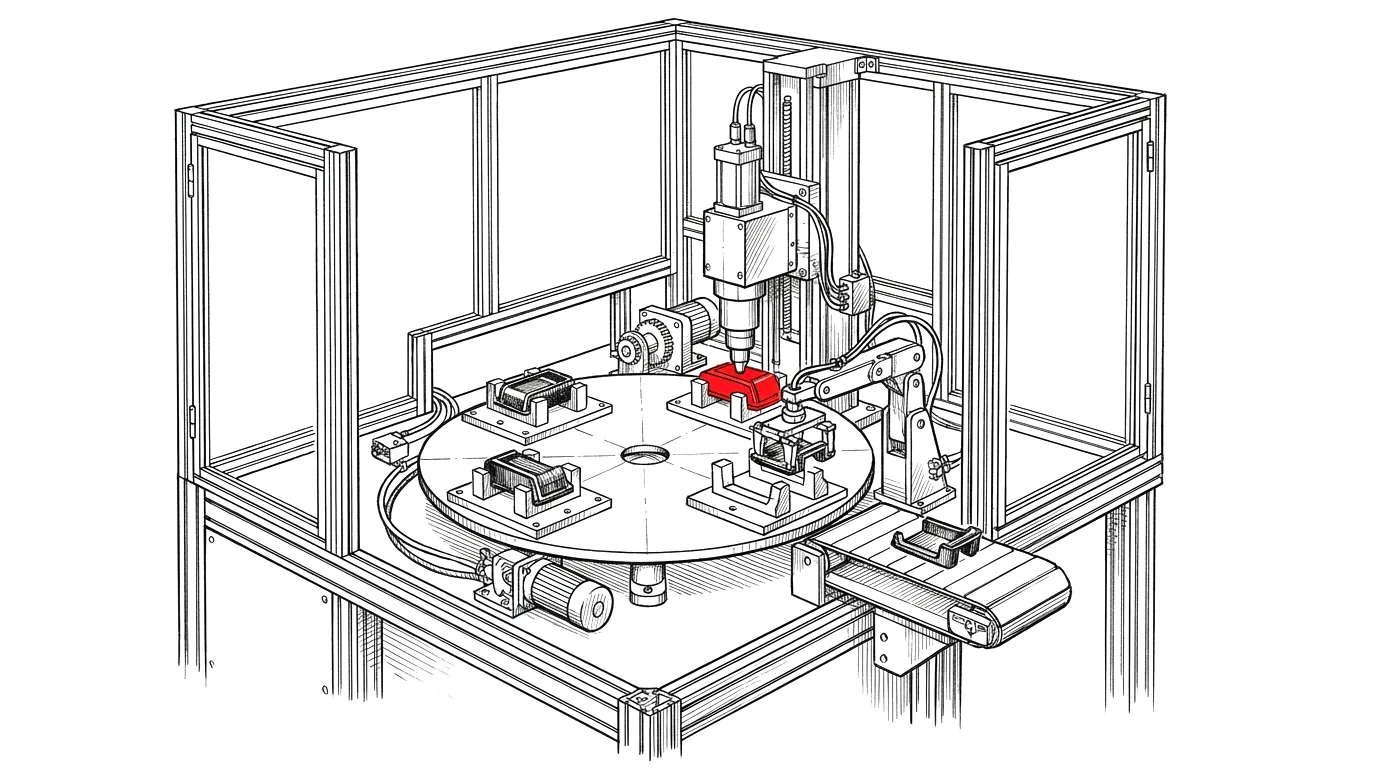
A rotary table with four fixtures. Parts are loaded at one station, by hand or by a robot, the welding head sits over the next, and at the last one a pick-and-place unit puts the finished part on a conveyor. We supply such a machine complete, with tooling and commissioning.
None of them is stupidity. They all come from deciding in a hurry with one figure missing that nobody asked for.
| The mistake | How it shows up | What to do |
|---|---|---|
| The technology is chosen after the mould is finished | The part has no energy director and no studs. Either the mould gets reworked or you reach for a more expensive technology. | Send the model for review before the mould is released for cutting. |
| Catalogue cycle time is taken at face value | The catalogue gives weld time, not cycle time. Real cycle time includes loading, unloading and checking. | Ask for the cycle time on your part, not the cycle time of the machine. |
| Tooling is left out of the budget | The price of the machine is not the whole investment. The tool is made for a specific part and repeats for the next shape. | The calculation has to include the machine, the tool and a reserve for a second shape. |
| Only today's part is considered | In two years a variant of the product arrives and the machine cannot take it, because it was bought to fit a single shape. | Say in advance what is coming. Headroom in the machine costs a fraction of a second machine. |
| Acceptance is never agreed | The machine arrives, something does not fit, and the contract has no sentence to lean on. | Acceptance at the manufacturer and at your plant, with measurable parameters and tied to payment. |
Samples are made before signing, from your material and wherever possible from your own mouldings. A sample made on a universal test piece tells you nothing about how your plastic with your filler will behave.
Acceptance happens twice. First at the manufacturer, where the machine runs a series of pieces and you verify that it holds the parameters. Second at your plant after installation, on your material and with your operators. It is the second acceptance that decides.
Payment milestones are tied to the acceptances. Part of the price on order, part after acceptance at the manufacturer and the rest only after acceptance at your plant. It is normal practice and it is open to negotiation.
What gets measured at acceptance:
All five belong in the contract. If nobody writes them down, neither side has anything to lean on.
Car makers and their suppliers often no longer buy individual machines. They order whole lines that assemble the part, weld it, laser mark it and finally leak test it.
The builders of such lines handle the handling, the screwdriving and the measuring. Welding plastics, though, is a field of its own, and developing it for the sake of one line does not pay.
That one step is what we can supply as a finished unit. It arrives with its tooling, with documentation and with parameters you can put straight into your own quote. The rest of the line is yours.
A price for your quote within 48 hours. Neither your brief nor your end customer goes any further from us.
What we supply into somebody else's line:
The range for the unit itself is EUR 10,000 to 20,000.
Typical parts and the technology used to join each of them. Usually faster than reading definitions.
Automotive
The clear lens is laser welded to the housing. The weld cannot be seen from outside and the lens stays perfectly clear. Ultrasonics would leave a milky mark on it.
Parts like these are joined with the technologies we supplyMedical technology
The two halves are ultrasonically welded with the membrane clamped between them. The weld has to stay tight and must not release a single particle into the fluid.
Parts like these are joined with the technologies we supplyElectronics
Plastic studs are formed over the board, so it holds without a screw and without adhesive. The heat must not reach the electronics.
Parts like these are joined with the technologies we supplyAutomotive
The two halves are vibration welded. The weld has to stay tight under pressure and in heat, which is why a bonded joint does not last as long as the car maker requires.
Parts like these are joined with the technologies we supplyTechnical parts
Both faces are heated by a plate and then pressed together. It handles large sections that ultrasonic power cannot reach.
Parts like these are joined with the technologies we supplyElectronics
Several parts are held together by formed studs alone. No screw, no nut and no assembly step that a person would otherwise have to do.
Parts like these are joined with the technologies we supplyTechnical textiles
Strips of coated fabric are high frequency welded. The seam holds better than a stitched one and does not let water through.
Parts like these are joined with the technologies we supplyA shortcut for anyone looking only for a similar case. The full atlas has over twenty parts and each one says why another technology does not suit it.
| Product | Sector | Technology | Why that one |
|---|---|---|---|
| Infusion and blood bags | Medical | high frequency welding | The bag is soft PVC and the seam has to stay absolutely tight even after sterilisation. |
| Air-inflated immobilisation splint | Medical | high frequency welding | Film welded around the edge into chambers. |
| Blister with a euro hook | Packaging | thermoforming and film sealing | The tray is formed, the product goes in, the top film is sealed and cut. |
| Food tray with a lidding film | Food | thermoforming and film sealing | Cheese, cured meats, fruit. The film seals the tray tight and the food stays visible on the shelf. |
| Sterile pack for a hypodermic needle | Medical | thermoforming and film sealing | Tray and lidding film are sealed tight, so the contents stay sterile until the pack is opened. |
| Sanitary product with a stainless cover, in four lengths | Sanitary ware | thermoforming and film sealing | One machine sized for the longest version. For the shorter ones only the mould changes. |
When you have a quote drawn up for a plastics welding machine, take twelve questions to the meeting that actually show the difference between one quote and another. Ask us the same ones.
Send us a photo, the material and a rough annual volume. Within 48 hours you know what will work, what will not, and roughly what the machine costs.
Better still, call. Five minutes on the phone will tell you more than the whole site. Petr Bernard answers it.
+420 777 981 981 info@tp-t.cz