A guide to buying a blister line
Most companies that come to us are dealing with a blister pack for the first time. They know what they need to pack, but not whether they need one machine or two, whether hand loading is enough, and above all what every further product size is going to cost them. That is what we go through with you before it comes to a quote.
Stand-alone machines start at EUR 40,000. If you need to weld plastics in smaller volumes, a separate page points you where to look.
What is on this page
If you read it and decide you can manage without us, we will take that as good news.
The word blister covers five quite different packs. Each one needs a different set of machines and a different tool, so it is worth knowing which of them we are actually talking about.
| Kind of pack | What it looks like | When it is used | What it means for the machine |
|---|---|---|---|
| Blister sealed to a card | The tray is sealed onto a printed card from one side. The most common pack on the shelf. | Light and medium weight goods, where the card carries the artwork and the euro hook. | The card has to be lacquered, or the seal will not hold. The tool is made to the card format. |
| Blister between two cards | The flange of the tray is trapped between two cards glued together. | Where it has to be obvious that someone has opened the pack. | One more step in the cycle, and a longer cycle with it. |
| Clamshell of two halves | The whole pack is film, welded or clipped around the edge. The card sits inside. | Heavier and more complex products, where a card would not hold the shape. | Both halves are formed, top and bottom. Higher film consumption. |
| Tray with a lidding film | A formed tray closed with a heat sealed film instead of a card. | Food, medical supplies, anywhere the pack has to stay tight. | Food contact material and traceability of the process both come into it. |
| Pocket pack for small goods | A shallow tray with several pockets, often with a printed lidding film. | Fasteners, small electronics, samples. | A high cavity count, because one stroke makes a lot of pieces. |
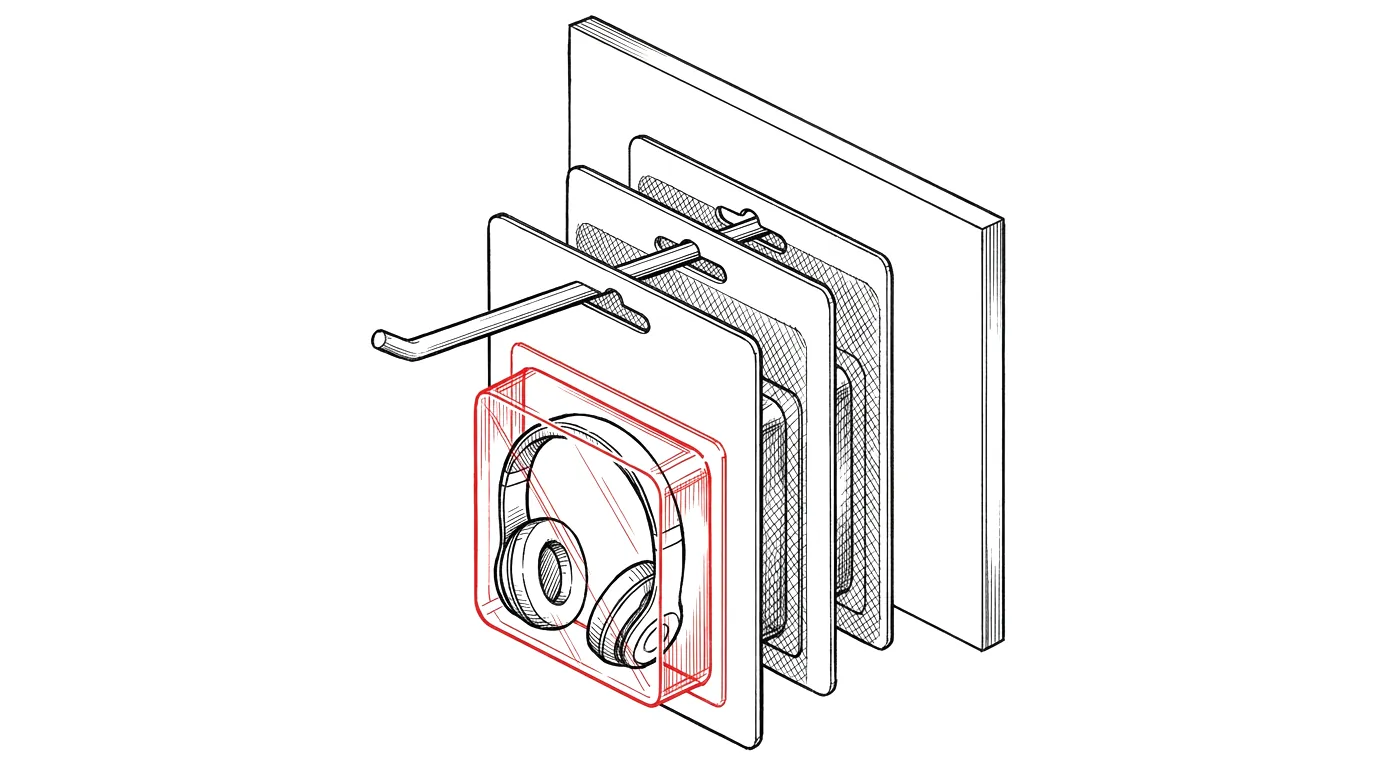
A euro hook, meaning the punched slot for hanging the pack, can be done on all five. On a card it is punched into the card, on a clamshell into the film, and there it has to be reinforced or it tears off the hook.
A blister is a clear tray with a heat sealed film or card. The customer can see into it on the shelf, it hangs on a hook, and the product survives transport and being returned from the store.
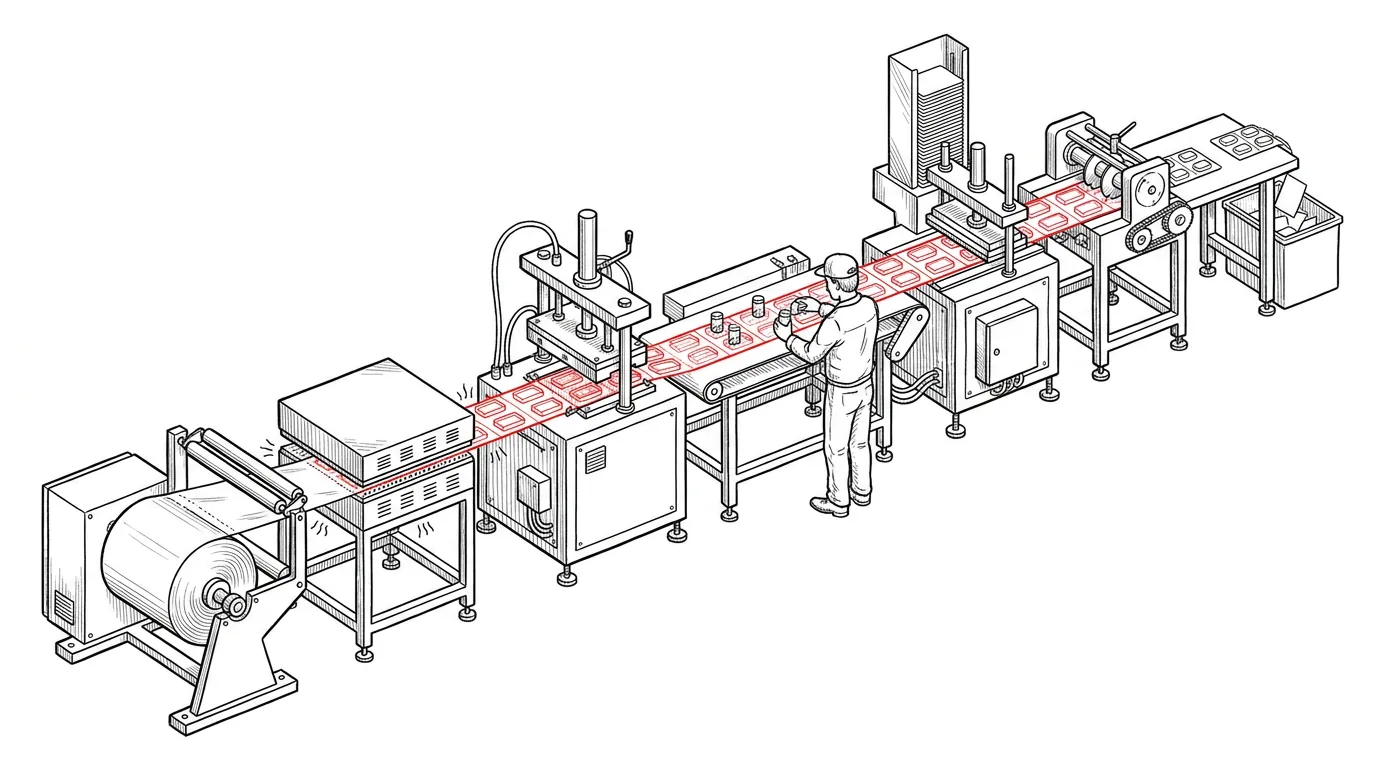
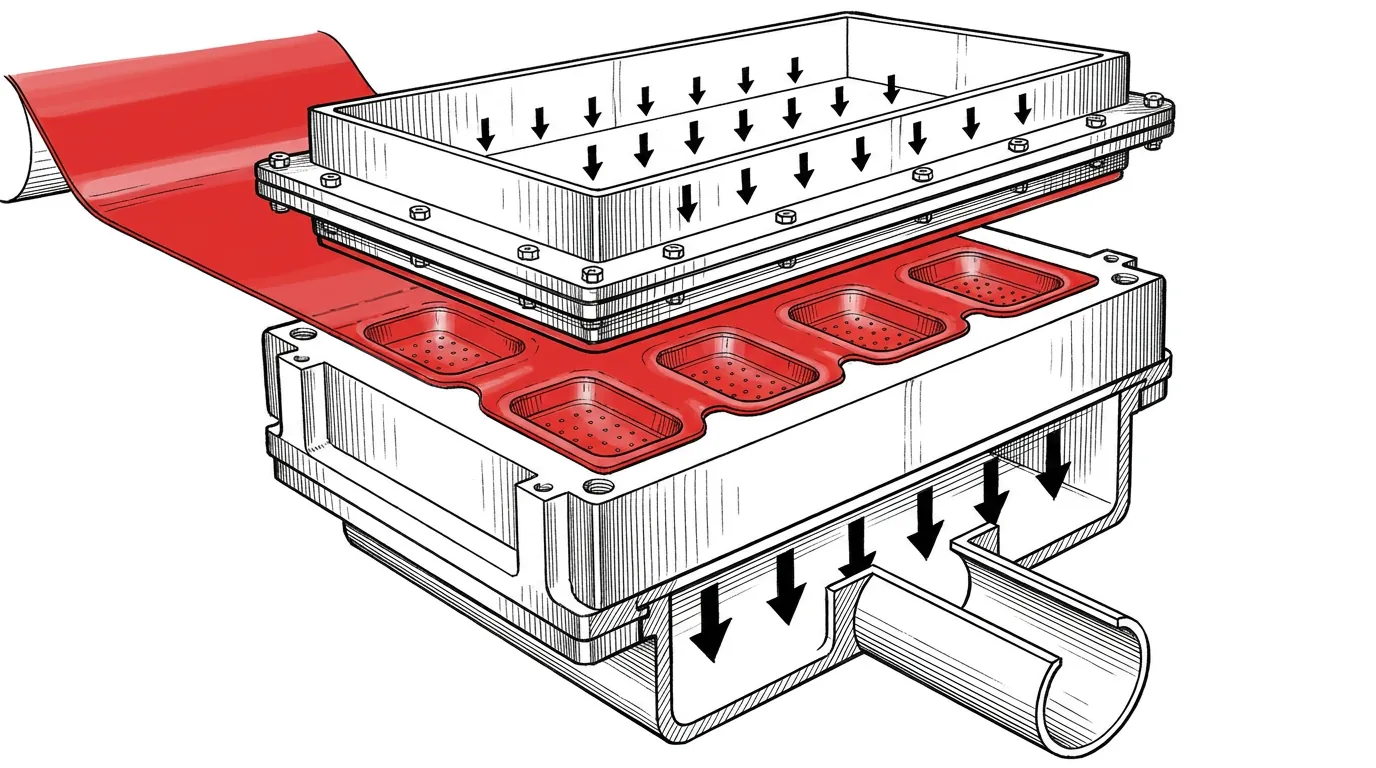
Heating and forming, steps two and three, are done by the forming machine. Steps five and six are done by the sealing machine. They can be bought separately or as a pair. If you buy your trays ready-made, the second one is all you need.
The drawing puts the whole set of machines in a row, the way it stands on the floor. Most people picture a blister line smaller than it is.
A shorter set-up starts at around eight metres, a longer one with a bigger magazine and an outfeed conveyor reaches twelve.
A line is typically around 1.5 metres wide and up to 12 metres long. On its own it takes roughly 18 m². That is not the area you need on the floor.
The line needs a handling area as well. That is room for incoming material, meaning film rolls and cards, for a stock of material at the loading station, and for finished goods coming off the line. It usually takes the same area as the machine, often up to twice as much.
And a truck has to reach the whole set-up. Material comes in and finished goods go out on a pallet truck, in a larger plant on a forklift. Plan the access lane from the start, not once the line is standing.
An example for a twelve metre line:
18 m² machine + 18 to 36 m² handling area = 36 to 54 m²
Plus the access lane for a truck. Send us a plan of the hall and we will tell you in advance whether the line fits, handling area included.
It is the first decision that gets made and it moves the price more than anything else. It comes down to whether you want to form the trays yourself or buy them ready-made.
| Your situation | What you need | What to watch |
|---|---|---|
| You buy trays ready-made from a packaging supplier | A sealing machine only. | Lower investment up front, but you pay somebody else's margin on every piece and you are tied to their lead times. |
| You want to form the trays yourself | A forming machine and a sealing machine. | Higher investment and more floor space. In return you pay only for film and you can bring in a new pack size whenever you want. |
| You do not know yet whether the product will take off | Start with the sealing machine and buy the trays. | The forming machine can be added later. Say so up front, so that the two halves fit together when the time comes. |
| You pack food or medical supplies | Both, and a traceable process with them. | A bought-in tray means somebody else is responsible for part of the process. For traceability that tends to be a problem. |
A rule of thumb: while you are in tens of thousands of pieces a year, buying trays is usually cheaper. In hundreds of thousands, forming them yourself normally pays for itself within the first two years. Where exactly that point sits for you is something we work out together.
The tray is formed from a roll of film. Most often PET, which is clear, forms well and can be recycled, then PVC, which is cheaper and forms more easily still, or PP and PS where the job is protection rather than appearance.
The lidding material is usually a printed lacquered card, aluminium foil or a plastic film. The lacquer on the card is not a detail, it is a condition. Without it the tray will not bond to the card and the seal holds only for a while.
The last decision is how the pack opens. Either it tears, which is cheap and suits consumer goods, or the lidding film peels off. The trade calls this a peel, or a peelable lid. It can also be made to stick back down, so the pack closes again, which the trade calls peel and reseal. Both cost more, but for medical supplies and food they are often the only option.
Film thickness is something we find together. Thicker film means a stronger pack, a longer cycle and a higher cost per piece. Thinner film saves material, but on a complex product it thins out in the corners until it cracks.
Four things that only come up in production, and by then it is too late:
All four can be ruled out during sampling, which takes a few days.
The catalogue gives strokes per minute. That is not the number of packs, and this is where most of the disappointment with a new line comes from.
Real output comes from three figures. How many strokes the machine makes per minute, how many pieces are in the tool on one stroke, meaning its cavity count, and what share of the shift the line actually runs.
The catalogue stroke rate is measured on a shallow tray in thin film that nobody loads by hand. Your shape will be deeper, the film thicker, and neither heating nor cooling can be taken out of the cycle. The real stroke rate is therefore noticeably lower.
The third figure has to cover roll changes, setting up, operator breaks and changeovers to another product. On single shift work with hand loading you normally count on seventy to eighty percent.
Ask for the output on your product, not the output of the machine. It is the only figure you can plan capacity with.
A calculation to do for yourself:
strokes per minute × cavity count × utilisation = pieces per minute
An example: eight strokes, four pieces in the tool and utilisation of 0.75 give 24 pieces a minute, which is 11,520 pieces in an eight hour shift.
If that leaves you short of your monthly volume, there are three routes: a higher cavity count, a second shift, or a faster machine. The cheapest is almost always the first.
It tends not to be about the pack itself. It tends to be about what the pack makes possible.
The store does not want bags. It wants a clear pack with a euro hook that can be hung up and that the product can be seen through. Without it you do not get on the shelf.
While you buy the pack ready-made, you pay somebody else's margin on every piece you make. With a line of your own you mainly pay for film.
Carting finished products to another company to be packed means double transport, double handling and waiting on somebody else's schedule.
Four segments where the enquiries come from most often. Each one asks something different of the film and of how clean the area has to be.
| Segment | Typical products | What matters |
|---|---|---|
| Consumer goods | Headphones, batteries, soothers, small electronics, hand tools. | The look of the pack, the euro hook, a printed lidding film. |
| Medical supplies | Hypodermic needles, sterile sets, single use items. | Sterility, a traceable process, clean surroundings. |
| Food | Sliced cheese and cured meats, fruit in trays, confectionery. | Food contact material, tightness, shelf life. |
| Technical and building products | Sanitary parts, fittings, components for assembly. | Protection in transport and a retail look at the same time. |
Do you make the same product in four sizes? Then you do not need four machines.
The outer dimension of the pack stays the same, because it follows from the machine. Only the inner shape of the tray changes. The machine is therefore bought for the largest of the sizes and another mould is made for the smaller variants.
A second and third mould cost a fraction of the machine. We allow for that when choosing, so that the line serves the products you are only preparing.
For the same reason it pays to mention what you are only planning. Headroom in the frame of the machine costs almost nothing. A second machine in two years costs full price.
Before we start calculating, we need to know:
That tells us whether hand loading is enough or an automatic machine pays off.
We see them over and over and every one can be ruled out by a single question asked in time.
| The mistake | How it shows up | What to do |
|---|---|---|
| The machine is bought for today's single product | A second size arrives and will not fit the frame. A second machine gets bought instead of a second mould. | Say up front what you are only preparing. Headroom in the frame is almost free. |
| Catalogue output is taken at face value | Capacity comes out a third lower than planned and a shift is missing. | Work the output out with the formula above, on your shape and your film. |
| The pack is designed without regard to the machine | A designer draws a card that will not fit any standard format. | Pack design and machine choice should run alongside each other, not one after the other. |
| Tooling and film are left out of the sum | The investment adds up, but cost per piece comes out differently and the payback moves by a year. | The calculation has to include the machine, the tool, the film and the energy. |
One customer started at a thousand pieces a month. When the product took off and sales tripled, they bought the same pair of machines a second time.
A machine is rarely bought for full utilisation. It is usually bought so that it runs at fifty to sixty percent. The rest of the capacity is not waste. It is the room in which you can pack products you cannot pack today.
You buy a blister line once and the quotes for it look much the same. Twelve questions from our buyer's guide show what actually sets them apart.
A blister line runs EUR 40,000 to 180,000 depending on the set-up. So you know straight away which order of magnitude we are in.
| What you are buying | Scope of supply | Rough range |
|---|---|---|
| Plastics welding: unit for your own line | the technology alone, without a frame | EUR 10,000 - 20,000 |
| Plastics welding: simplest machine | one weld, manual loading | EUR 40,000 - 60,000 |
| Plastics welding: usual machine | two to four weld points | EUR 60,000 - 120,000 |
| Plastics welding: more demanding part | eight or more weld points | EUR 120,000 - 180,000 |
| Blister packaging: sealing machine | you buy the trays ready-made | EUR 40,000 - 80,000 |
| Blister packaging: forming and sealing | you form the trays yourself | EUR 90,000 - 180,000 |
| Complete purpose-built line | assembly, welding, marking and part testing, or a full blister line | EUR 150,000 - 400,000 |
| Replacement tool for a machine you already have | another shape of the same product | a few thousand to tens of thousands of EUR |
The table covers both halves of what we supply: machines for welding plastics and lines for blister packaging. Prices are for a machine including one tool. Nobody can give you an exact figure before they know the brief. For a first calculation this is enough. What moves the price of your machine most
Give us the size, the monthly volume and whether the pack needs a euro hook. Within 48 hours you know what set of machines will do it and what it will cost.
Better still, call. Five minutes on the phone will tell you more than the whole site. Petr Bernard answers it.
+420 777 981 981 info@tp-t.cz