For moulders and makers of plastic parts
Once you weld the mouldings yourself, you stop supplying your customer with a semi-finished part and start supplying a finished assembly, which pays better. You stand behind the quality yourself and you reach work you currently have to turn down. We will work out what that means at your volumes and how long a machine would take to pay for itself.
Stand-alone machines start at EUR 40,000. If you need to weld plastics in smaller volumes, a separate page points you where to look.
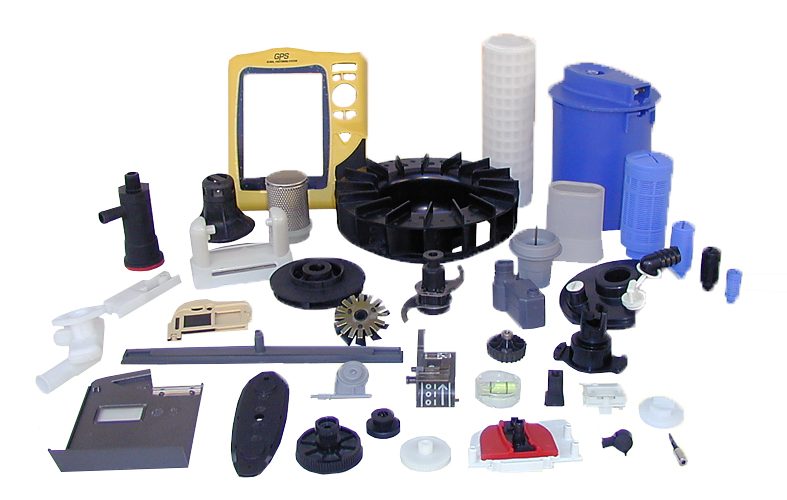
We have been supplying machines for welding plastics and lines for blister packaging to Czech and Slovak plants since 2005. A fair amount gets learned in that time, and it is exactly what you get from us before you get a quote. Among our customers:











Three specific things, not general promises.
For every piece you send out to be welded, you pay another company for one production step. On a run of hundreds of thousands that is a figure you will see in the annual accounts.
You move a floor up the supply chain and start bidding for work you cannot reach today.
In the automotive industry that weighs as much as the money. Whoever has the whole process in house is not waiting for a result from another company and has nothing to claim back from them.
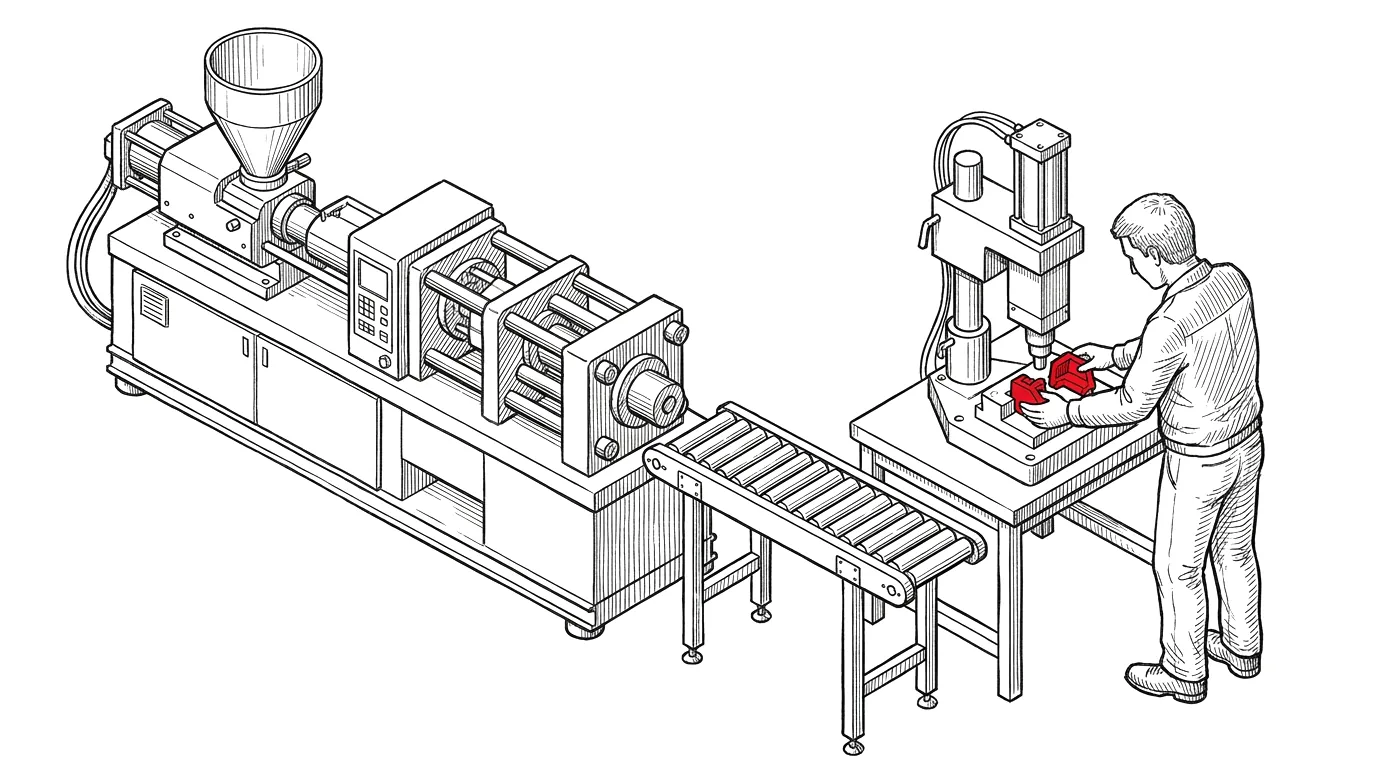
Welding follows moulding. A part straight out of the press is warm and has to cool down first so that its properties settle. That is why it is usually not welded right at the press but at a separate workstation in the same hall.
The part no longer travels to a subcontractor and back. It is welded in your plant and your customer receives a finished assembly.
The number of plastics processors has been falling in recent years, and one of the reasons comes up more and more often when we visit companies: good people for the shop floor cannot be found. Anyone building a new job today on the assumption of hiring four of them is building on sand.
You do not buy a machine to save on wages. You buy it because those people are not there and will not be. Saving on wages can wait until next year. A job you have nobody to make cannot.
A machine also gives you new capacity and a new production step. You can then offer your customers a much wider range of work than today.
A machine is rarely bought to run flat out.
The usual aim is fifty to sixty percent utilisation. The rest is not waste. It is the room in which you can offer work you could not offer before.
Today you are a moulder. Add assembly and welding and you have two trades instead of one. And the second one pays better.
What you need for it:
If the calculation says it will not pay off, we will write that too.
So you know the figures the calculation starts from.
| What you are buying | Scope of supply | Rough range |
|---|---|---|
| Plastics welding: unit for your own line | the technology alone, without a frame | EUR 10,000 - 20,000 |
| Plastics welding: simplest machine | one weld, manual loading | EUR 40,000 - 60,000 |
| Plastics welding: usual machine | two to four weld points | EUR 60,000 - 120,000 |
| Plastics welding: more demanding part | eight or more weld points | EUR 120,000 - 180,000 |
| Blister packaging: sealing machine | you buy the trays ready-made | EUR 40,000 - 80,000 |
| Blister packaging: forming and sealing | you form the trays yourself | EUR 90,000 - 180,000 |
| Complete purpose-built line | assembly, welding, marking and part testing, or a full blister line | EUR 150,000 - 400,000 |
| Replacement tool for a machine you already have | another shape of the same product | a few thousand to tens of thousands of EUR |
The table covers both halves of what we supply: machines for welding plastics and lines for blister packaging. Prices are for a machine including one tool. Nobody can give you an exact figure before they know the brief. For a first calculation this is enough. What moves the price of your machine most
Typical parts where two mouldings become a finished assembly.
Medical technology
The two halves are ultrasonically welded with the membrane clamped between them. The weld has to stay tight and must not release a single particle into the fluid.
Parts like these are joined with the technologies we supplyElectronics
Plastic studs are formed over the board, so it holds without a screw and without adhesive. The heat must not reach the electronics.
Parts like these are joined with the technologies we supplyTechnical parts
Both faces are heated by a plate and then pressed together. It handles large sections that ultrasonic power cannot reach.
Parts like these are joined with the technologies we supplyAnswers you do not usually find on a supplier's site.
The simplest stand-alone machine runs EUR 40,000 to 60,000. A usual machine with two to four welding points, EUR 60,000 to 120,000. A whole special purpose line with assembly, marking and inspection can reach EUR 400,000.
What moves the price most is the number of welding points, the cycle time you need and the size of the part. In that order.
Because we pick the technology to suit your part, not to suit a brand. If one name stood on the site, it would look as though we sell one brand and one technology.
We go through the particular manufacturer with you in person, once it is clear what your part needs.
Five to eight months from order. If you need to be producing in January, the order has to be signed roughly a year ahead and you need the quote on the table earlier still.
That is why it is worth getting in touch while you are still negotiating the contract, not once you have signed it.
You call us first and in most cases the fault is settled over the phone. Newer machines can be diagnosed remotely.
Most spare parts you buy from an ordinary local wholesaler, because they are standard relays, contactors and switches. When an engineer is needed, they come from the manufacturer and already know which part to bring.
Sometimes it does not and we will tell you so straight away. At a few thousand pieces a year a machine at EUR 40,000 will not pay for itself.
In that case we point you to where to look for simpler equipment or who to subcontract the part to. There is no sense selling you something that will stand idle in your plant.
Yes, and most customers want to. Either at a company that runs the same machine, or at the manufacturer while your own machine is on the floor before shipping.
When the dates do not line up, we do a video call from a machine that is running at that moment.
The machine usually stays and only the tooling changes. On products of a similar shape often only the inside of the tool changes, because the outer dimension stays the same.
A second and third tool therefore cost a fraction of the machine. We allow for that when choosing, so that the machine still serves what you will be making in five years.
We will work out what that step costs you and how long a machine would take to pay for itself.
Better still, call. Five minutes on the phone will tell you more than the whole site. Petr Bernard answers it.
+420 777 981 981 info@tp-t.cz